
Phrasal verbs related to Family

Family Phrasal Verbs


Get along with someone

The phrasal verb get along means ‘to have a good relationship with someone.
  • You must get along with your brother.

Take after someone

“Take after someone” means ‘to look or behave like an older member of your family’.
  • Generous! She takes after her mother.
  • In looks, he takes after his father.

Look up to someone

The phrasal verb “look up to” means ‘to admire or respect someone’.
  • I’ve always looked up to my uncle.

Bring someone up

To bring someone up means ‘to care for a child, to raise a child’.
  1. She was brought up by her grandparents.
  2. Susan brought up three children on her own.

Comments

Popular posts from this blog

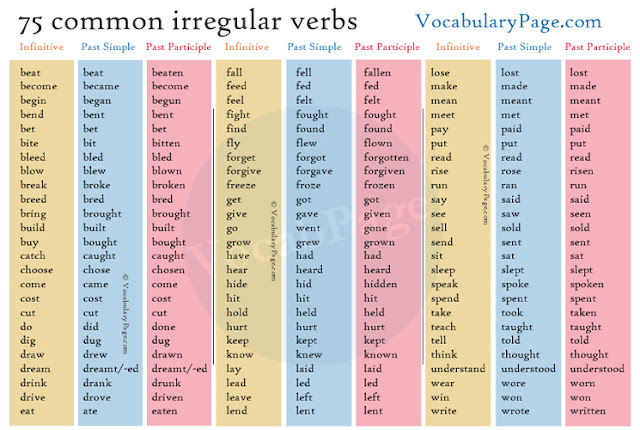
List of irregular verbs

In English, verbs can be regular or irregular .   

Colors in English

'What's your  favorite   color ?', 'What  color  are your eyes?' or 'What  color  is the car?' - these are the most common questions about  color  in English.  If you know the names of the  colors  in English, you will answer those questions .   Here is the list of the most common  colors :  

Nouns

The simplest definition of a noun is that it is a word that refers to a person (such as John or teacher), thing (such as ball or table), place (such as Harvard or university), or idea (such as love or emotion). What is a Noun? Countable Nouns and Uncountable nouns Some nouns can be counted and they are called countable nouns. Some nouns cannot be counted and they are called uncountable nouns.  Common Nouns and Proper Nouns Names of people, places, and things are called proper nouns. They always begin with capital letters. All other nouns are common nouns.  noncount-nouns.html Collective Nouns Words such as family, team or bunch are collective nouns. They can be used with either a singular or a plural verb. Abstract and Concrete Nouns If your five physical senses (sight, smell, hearing, taste, and touch) cannot detect something, it is an abstract noun.  Gender-specific nouns In some languages, nouns refer to specifically to males or females....