Personal pronouns

Personal Pronouns

Personal Pronouns
Subject
Object
I
Me
You
You
She
Her
He
Him
It
It
We
Us
You (pl)
You
They
Them

Personal pronouns refer to specific people or things. There are two cases of personal pronouns: Subject pronouns and object pronouns.

Subject pronouns


Subject pronouns are used as the subject of a verb.
There are eight subject pronouns:
  • I: the speaker or writer
  • You: a person being mentioned
  • He: a male person
  • She: a female person
  • It: an animal or a thing
  • We: I and another person (or other people)
  • You: people being mentioned
  • They: People or things

Object pronouns

Object pronouns are used as the object of a verb. They include:
  • Me: Object form of I
  • You: Object form of You
  • Him: Object form of He
  • Her: Object form of She
  • It: Object form of It
  • Us: Object form of We
  • You: Object form of You (pl)
  • Them: Object form of They

Sentence examples:


She knows English.
I sent her a letter.
They are my friends.
I want to invite them to the party.
It is on the table.
I put it on the table.
I will tell you.
Give her the letter.
I will come with them.


Comments

Popular posts from this blog

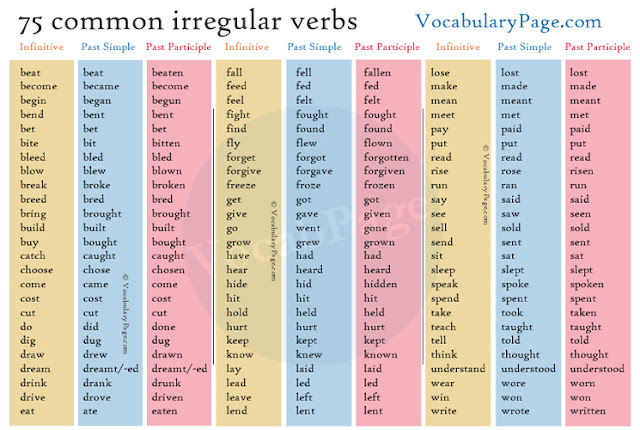
List of irregular verbs

In English, verbs can be regular or irregular .   

Colors in English

'What's your  favorite   color ?', 'What  color  are your eyes?' or 'What  color  is the car?' - these are the most common questions about  color  in English.  If you know the names of the  colors  in English, you will answer those questions .   Here is the list of the most common  colors :  

Nouns

The simplest definition of a noun is that it is a word that refers to a person (such as John or teacher), thing (such as ball or table), place (such as Harvard or university), or idea (such as love or emotion). What is a Noun? Countable Nouns and Uncountable nouns Some nouns can be counted and they are called countable nouns. Some nouns cannot be counted and they are called uncountable nouns.  Common Nouns and Proper Nouns Names of people, places, and things are called proper nouns. They always begin with capital letters. All other nouns are common nouns.  noncount-nouns.html Collective Nouns Words such as family, team or bunch are collective nouns. They can be used with either a singular or a plural verb. Abstract and Concrete Nouns If your five physical senses (sight, smell, hearing, taste, and touch) cannot detect something, it is an abstract noun.  Gender-specific nouns In some languages, nouns refer to specifically to males or females....